
Rooted in Legacy: The Story of Focal Point Trees
More than a tree farm, Focal Point Trees is the continuation of a family story shaped by land, service, resilience, science, craftsmanship, and more than four decades of learning from trees themselves.
“My father loved this property and I wanted to see it productive for both of us.”
A Tree Farm With a Story Behind It
Long before it was known as Focal Point Trees, the business began with a piece of family land in Lavonia, Georgia, and a desire to make that land productive without losing what it represented.
For John Shearouse, the history of the farm cannot really be separated from the history of his family. The land, his love of the outdoors, his interest in science, and the example set by his father all became part of the foundation for the work that would eventually grow into Focal Point Trees.
The Roots Came Before the Nursery
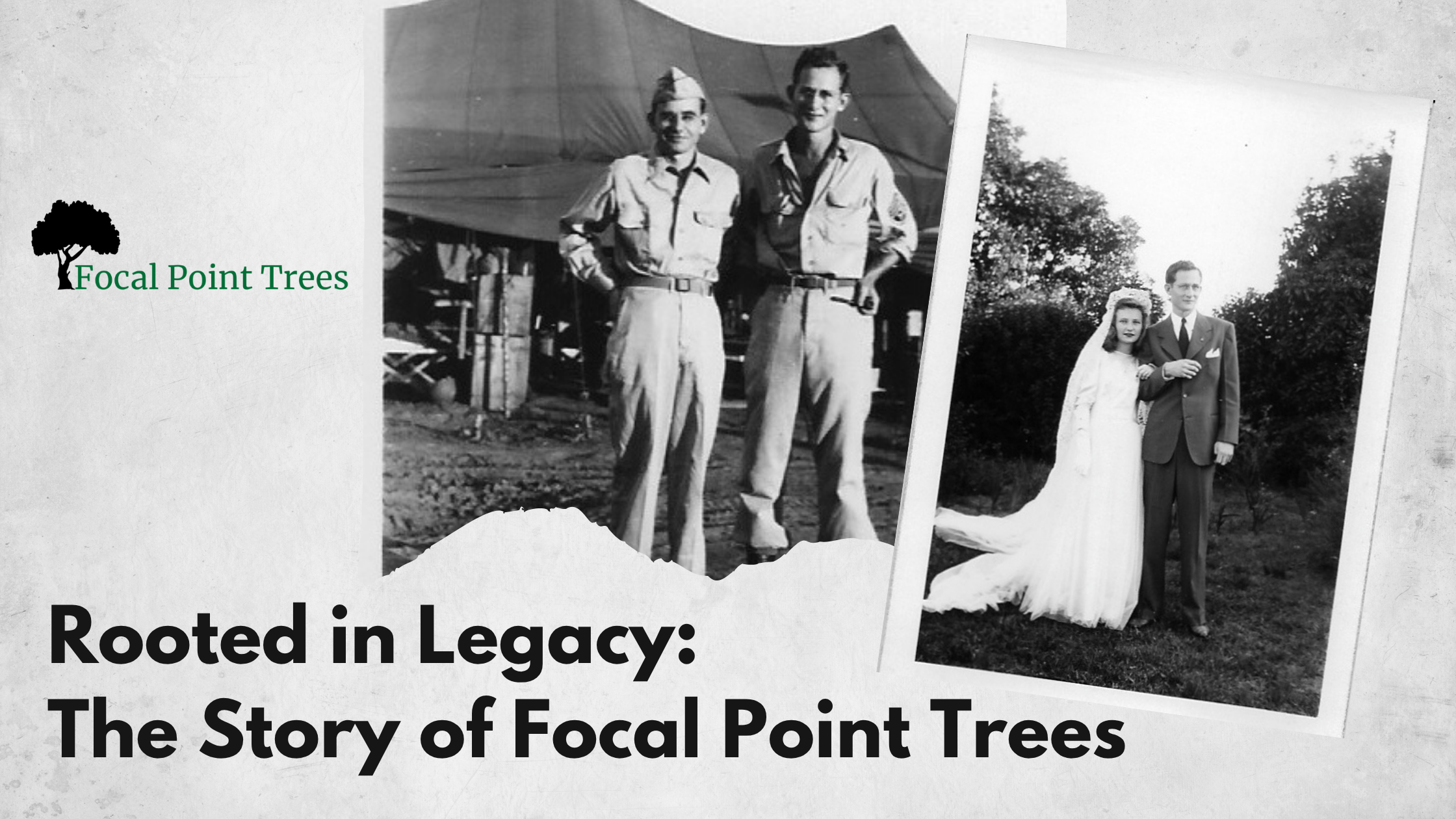
John’s father, John N. Shearouse Jr., was born in Brooklet, Georgia, in 1919 and grew up during the Great Depression. In 1942, he enlisted in the U.S. Army and spent two and a half years in the Pacific serving as an Army medic during World War II. After returning home, he married Dorothy Brannen, continued his education, and eventually completed medical school.
When the family settled in Lavonia, John’s father became one of the small town’s family doctors. His work was personal and demanding. He made house calls, delivered babies, responded to emergencies at all hours, and went out in difficult weather when someone needed him. John remembers him as hardworking, reassuring, and positive, someone who rarely complained even when the work was difficult.
His father rarely spoke about his years in the Pacific, but John came to understand how deeply those experiences had shaped him. John’s philosophy became a sense that his father could endure those years, almost anything was possible. That tenacity and durability became part of what he passed on to his son. Even today, John keeps a photograph of his father and his Uncle Winburn in the Pacific as a reminder to keep difficult days in perspective.
There was another inheritance as well: a love of the natural world. John’s father enjoyed hunting, fishing, and being outdoors, and he encouraged John’s growing interest in biology and science. As a boy and teenager, John was drawn to scouting, wildlife, herpetology, fishing, and the outdoors. His father joined him for occasional hunting afternoons, helped with school biology projects, and shared time with him on the family property in Lavonia.
That property was a 33-acre tract of farmland on Wrights Branch that John’s father had purchased. John remembers walking the stream and open land with him, and his parents had begun building a home there when John was still a teenager. When his father passed away, after an illness that teenage John had not known about, the loss changed John deeply. The property remained, not simply as acreage, but as one of the tangible connections to his father and to the life his family had imagined there.
A Piece of Land That Needed a Future
John went on to earn a B.S. in Biology from Piedmont College in 1980, studying subjects that would later prove unexpectedly useful in tree propagation, including plant biology and genetics. In the years that followed, he worked on major commercial construction projects and traveled extensively. Along the way, he saw impressive landscapes, met landscape professionals, and watched large trees being installed on job sites.
Back home, about 18 acres of fertile farm land needed attention and a purpose. John needed to create income in a rural area, but he also wanted a life that did not require traveling most of the year. Selling the land was one option. Finding a way to make it productive was another.
For John, that decision carried meaning beyond economics. His father had loved the property, and John wanted to see it become productive for both of them. Growing trees brought several pieces of his life together at once: the land, his biology background, his lifelong connection to the outdoors, and the desire to build something lasting on a place that already held family history.
The answer began, quite literally, with a handful of seeds.
From Seed Beds to a Tree Nursery
In the mid-1980s, John began experimenting with tree propagation on the farm. At first, the operation was small and intensely hands-on: raised seed beds, shade cloth, carefully timed cold stratification, young seedlings, detailed recordkeeping, and a constant cycle of observation and adjustment.
Maples, magnolias, redbuds, dogwoods, and other species were part of the early years, but Japanese maples, Trident maples, and red maples soon became a major focus. Thousands of seedlings were produced as John refined methods, studied genetics, learned which parent trees produced the strongest or most distinctive offspring, and discovered how much tree production depends on timing, patience, and attention to detail.
There was no shortcut to that education. Books provided a foundation, but the real classroom was the farm itself: weather, soil, pests, growth patterns, successes, losses, and the day-to-day realities of caring for acres of trees. Over time, the work became less about simply growing more trees and more about understanding what made a tree exceptional.
A Craft Refined Over Decades
By 1996, John was at the tree farm full time. Production expanded from seed beds and small containers to larger container trees and field-grown specimens. Japanese maples from the farm began traveling throughout the Southeast, and larger balled-and-burlapped trees became an increasingly important part of the business.
Years of seedling production also revealed the remarkable variation that could come from carefully selected parent trees. John collected seed from hundreds of Japanese maple parent trees around the Southeast, studied their offspring, and continued selecting for strength, consistency, distinctive form, and other desirable traits. Many of the trees growing on the property today came out of those years of observation and selection.
As the trees grew larger, so did the emphasis on form. A specimen tree was no longer viewed as a commodity with a size attached to it. Its branching structure, shape, mature scale, and eventual setting all mattered. A tree destined for a courtyard might need a completely different form from one planted beside a walkway, near a window, over a water feature, or as the focal point of a garden.
That way of thinking became part of the identity of the farm: grow the tree with its future in mind.
Resilience Changed the Business
The economic downturn of 2007 and 2008 became a defining chapter. Tree sales and landscape work slowed dramatically across the industry, forcing production to change. Fewer trees could be sold, labor had to be minimized, and the business had to adapt to survive.
Instead of abandoning the work, John used the slow years to study. He deepened his knowledge of arboriculture, became an ISA Certified Arborist, and shifted even more attention toward larger, unusual specimen trees. Some Japanese maples that could not be sold during the recession were planted in the ground and allowed to mature. Years later, those same trees became remarkable large-caliper specimens, living proof that a difficult season can become part of a tree’s value rather than the end of its story.
The experience reinforced something that remains central to Focal Point Trees today: trees cannot be rushed. The best results come from patience, adaptation, careful observation, and an understanding of the conditions in which a tree will live for decades to come.
What Focal Point Trees Means Today
Today, Focal Point Trees represents more than forty years of propagation, production, installation, research, and lessons learned on real properties. What began as Shearouse Nursery evolved into Focal Point Trees LLC, but the foundation has not changed. The work is still rooted in the same land, the same curiosity about how trees grow, and the same belief that a well-chosen tree can become one of the most meaningful features of a property.
That meaning is especially clear in the farm’s specimen and memorial trees. A tree can mark a life, define a place, soften a structure, anchor a garden, or become the feature a family watches change through the seasons. Over time, it can become part of the memory of a home or property itself.
This is why Focal Point Trees is not simply about selling trees. It is about matching the right tree to the right place, understanding the site, respecting the long life of the plant, and giving each tree the best chance to become something lasting. The goal is not just for a tree to look good on installation day. It is for that tree to thrive, mature, and continue giving back for years to come.
A Legacy Measured in Years, Not Seasons
A tree farm teaches patience in a way few businesses can. Some of the most distinctive trees at Focal Point Trees have been shaped, pruned, studied, and cared for over decades. Their value is not only in their size or color. It is also in the years of knowledge invested in them and in the years they may continue to give back once they are planted in their permanent home.
For John, that idea brings the story back to where it began. His father worked hard, served his community, loved the outdoors, and left behind an example of endurance that stayed with his son. John took the land his father loved and built a life’s work on it, one rooted in patience, care, science, and the belief that what we nurture today can carry meaning far into the future.
There is something fitting about a family legacy being carried forward through trees. Trees can outlive the season in which they are planted. They can become markers of memory, gathering places, memorials, and familiar parts of a landscape that future generations come to know.
Focal Point Trees grew from family land, necessity, curiosity, and a desire to make something meaningful. Today, it continues that story one tree at a time: thoughtfully grown, carefully selected, and planted with the future in mind.